A dessert that looks like a real mango. You cut into it – and find mousse, fruit filling and sponge base. This “reveal” moment has generated hundreds of millions of views on TikTok and Instagram and triggered one of the strongest food trends of 2026: Frozen Fruit Desserts – hyperrealistic fruit-shaped desserts that combine patisserie art with frozen convenience.
What began in Parisian star kitchens under Cedric Grolet has long since arrived in European grocery retail. EDEKA, Kaufland and the first specialists are already listing fruit ice products. The premium segment – real patisserie quality in fruit form – is, however, still largely unoccupied. For buyers and category managers an extraordinary opportunity opens up here.
From Parisian patisserie to TikTok: The origin of a mega-trend
The story of this trend begins with one man: Cedric Grolet, Executive Pastry Chef at the Parisian luxury hotel Le Meurice and named the world's best Pâtissier by World's 50 Best in 2018. Grolet perfected a technique that had existed in patisserie for longer but never at this level: hyperrealistic fruit desserts – so-called trompe-l'œil creations that are visually indistinguishable from real fruit.
His lemons, mangos and apples made of mousse, ganache and sponge exploded on Instagram. More than 800,000 followers watched as Grolet cut open an apparently real fruit to reveal a multi-layered dessert work of art. This “reveal” moment – the tension between expectation (real fruit) and surprise (patisserie masterpiece) – became the blueprint for a global trend.
What Grolet sold in limited edition for 18 euros per piece in Paris inspired producers worldwide. The question was no longer whether this concept would be mass-market capable, but when and how. The answer came faster than expected – via TikTok.
The TikTok effect: Fruit ice cream conquers the world
The leap from niche trend to mass phenomenon happened via social media. Several developments drove the viral wave:
Propitious Mango from China kicked things off: a mango ice in perfect mango shape that generated millions of views on TikTok with its reveal moment – cutting open the realistic shell, behind it creamy mango ice. The videos spread rapidly under hashtags like #FruitIceCream and #MangoIce.
3D Fruit Ice Cream from Japan followed at the end of 2025, imported by Gold Star Import. Japanese manufacturers transferred the idea to further fruit varieties and perfected the optical illusion. The aesthetically pleasing products were made for the visual culture of TikTok and Instagram.
Then European retail reacted: EDEKA launched the brand “FruPop” in November 2025 together with TikTok rapper Zahide – soy-based fruit-shaped ice, vegan, at an RRP of EUR 2.99. The collaboration with a social-media creator was no coincidence: EDEKA understood that this trend is digitally driven and the target group must be engaged where it spends its time.
Kaufland was even earlier: already in July 2025 the Schwarz Group listed fruit ice under the own brand “Friends of Asia” in the flavours mango, lemon and peach – promoted by influencer Kiki, at EUR 1.99. A clear signal: European retailers are already investing massively in this segment.
Market signal
EDEKA and Kaufland set the pace in 2025 – the premium segment is the next stage. While the discounter variants compete on price, retail lacks an offer that combines real patisserie quality with the fruit-dessert trend.
Market data: An 8-billion-dollar market with growth
Behind the viral hype there are hard numbers that underpin the trend:
Germany is the largest frozen-dessert market in Europe with a volume of USD 8.25 billion (2024). The European total market stood at USD 32.46 billion in 2025 and will grow to USD 48.25 billion by 2033 – an annual growth rate (CAGR) of 5.08%.
Particularly dynamic is the non-dairy and plant-based segment: from USD 3.28 billion it will grow to a forecast USD 11.69 billion by 2034 – a CAGR of 15.25%. Frozen Fruit Desserts benefit twice from this trend, since many variants are naturally plant-based.
The frozen fruits market in Europe also shows strong growth: from USD 9.33 billion to USD 14.44 billion by 2034. The convergence of frozen desserts and frozen fruits – exactly where fruit desserts are positioned – is one of the most exciting growth areas in the entire frozen-food industry.
Another number underscores the premium trend: 70% of consumers prefer artisanal quality over industrial mass-produced goods. For retail this means: volume is growing, but margins sit in the premium segment.
Clean label and premium: What consumers really want
The frozen-fruit-dessert trend meets a deep shift in consumer behaviour. The days when frozen desserts with artificial flavours and long ingredient lists were accepted are over.
70% of European consumers actively avoid products with artificial preservatives. At the same time, already 30% of all food new launches carry a clean-label claim. The trend away from “ultra-processed food” (UPF) towards real, recognisable ingredients is no longer a niche – it is mainstream.
What consumers concretely expect:
- Real fruit instead of fruit flavouring – noticeable and visible on the ingredient list
- Less sugar – natural sweetness from fruit instead of added sugar
- No E-numbers – short, understandable ingredient lists
- Plant-based options – not as renunciation but as a conscious choice
- Artisanal feel – patisserie quality instead of industrial goods
Frozen Fruit Desserts in the premium segment meet these expectations perfectly: they are based on real fruit puree, use natural ingredients and, through their artistic visuals, convey exactly the artisanal quality consumers are looking for. No other frozen-dessert format combines these attributes so convincingly.
The craft behind realistic fruit desserts: Why quality makes the difference
What looks so effortless on TikTok is a huge challenge in production. Producing hyperrealistic fruit desserts in consistent quality and sufficient volume requires know-how, investment and precision at a level that most manufacturers cannot offer.
Craft meets engineering
Custom silicone moulds are the foundation: each fruit variety needs its own, highly precise mould that replicates the natural texture and geometry of the fruit to the millimetre. The development of a single mould takes months and costs a five-figure sum.
The multi-layered structure – mousse, sponge base, fruit filling, glaze – must be identical in every piece. Each layer has different temperature requirements, different setting behaviour and different timings. A mistake in one layer ruins the entire dessert.
The airbrush technique for the natural colour gradients of a mango or strawberry requires trained personnel and exact colour blending. Too strong, and the dessert looks artificial. Too pale, and the wow effect is lost. The glaze itself must be applied at exactly 32 °C – one degree more or less changes the result.
The scaling hurdle
The biggest challenge lies in ice recrystallisation: during freezing and storage, ice crystals form that can destroy the delicate mousse texture. Only through controlled blast freezing and an unbroken cold chain can patisserie quality be preserved.
On top come high raw-material costs: real fruit puree instead of flavour, Belgian chocolate for the glaze, high-quality butter for the sponge. The ingredient costs of a premium fruit dessert are several times higher than those of a conventional frozen ice cream.
That is why, despite the enormous market potential, only a few suppliers can deliver true premium quality. The entry hurdles – technical, financial and personnel – are high. For retail this means: whoever has a reliable supplier with proven quality holds a genuine competitive advantage.
Maison de Patifruits: Premium Frozen Fruit Desserts for European retail
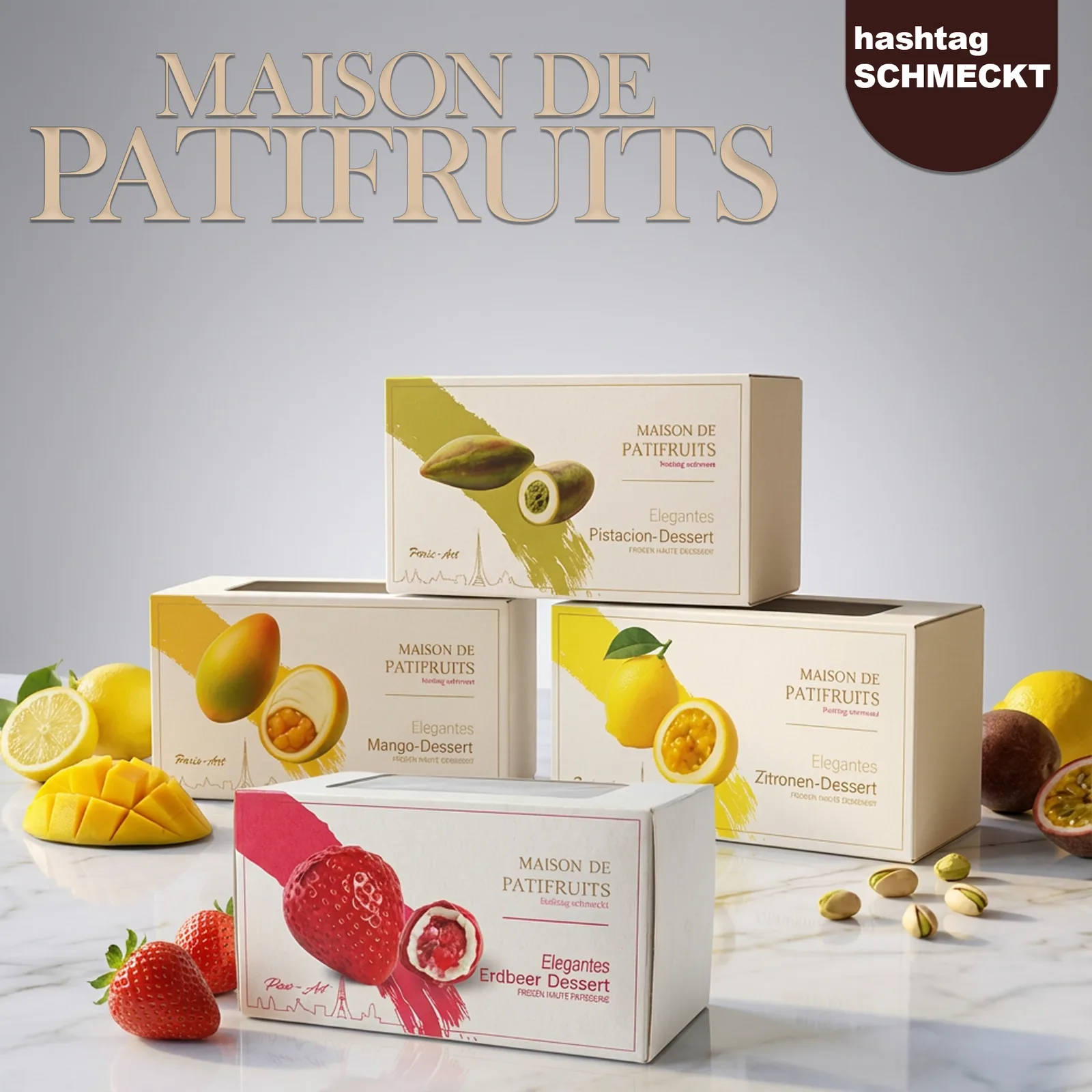
This is exactly where Maison de Patifruits comes in: the brand combines the art of French Haute Patisserie with the availability that modern retail needs. “Frozen Haute Patisserie” – as the brand promises – means: every dessert has the level of a starred restaurant but can be stored in the home freezer and served in minutes.
Four flavours, one quality promise
Maison de Patifruits starts with four flavours, each covering a different flavour world:
| Flavour | Flavour profile | Weight | RRP |
|---|---|---|---|
| Mango | Exotic-fruity, mango mousse & mango puree | 120 g | EUR 5.99 |
| Lemon | Refreshing-tart, lemon mousse & citrus core | 120 g | EUR 5.99 |
| Pistachio | Nutty-elegant, pistachio mousse & nut crunch | 120 g | EUR 5.99 |
| Strawberry | Classic-berry, strawberry mousse & fruit filling | 120 g | EUR 5.99 |
Every dessert follows a three-layer structure: on the outside a perfectly shaped, naturally coloured fruit glaze. Underneath an airy mousse with real fruit flavour. In the core an intense fruit filling that creates the characteristic reveal moment when cut – on a sponge base that gives the whole substance and texture.
Logistics & trade conditions
| Trade & Logistics | |
|---|---|
| Packaging unit | 12 carton |
| Cartons per pallet | 224 cartons |
| Lead time | 2-5 working days |
| Storage | Frozen (-18 °C) |
| Positioning | Premium segment, frozen dessert |
| Distributor | VOVAN Global GmbH |
The positioning in the premium segment is deliberate: while the mass-market variants of EDEKA and Kaufland sit between EUR 1.99 and EUR 2.99, Maison de Patifruits offers a significantly higher-quality product at RRP EUR 5.99 – with correspondingly higher margins for retail. Differentiation via quality, not price, protects against price wars with discounters.
More on the brand and the full range on the Maison de Patifruits brand page.
Why B2B buyers should back fruit desserts now
The arguments for listing Premium Frozen Fruit Desserts are compelling – and they apply now, not in a year:
1. The trend has arrived in European retail
EDEKA and Kaufland opened the category in 2025. Consumers know the concept, demand is there. Those who enter now no longer have to explain the market – they can offer the better product.
2. The premium segment is underserved
The current offerings in retail position themselves as mass-market goods at low price points. Real patisserie quality in fruit form is almost entirely missing. Those who list first occupy a niche with high margins and little competition.
3. Differentiation versus discounters
Premium Frozen Fruit Desserts are not a product Aldi or Lidl can copy tomorrow. Production complexity protects against quick imitation. Full-range retailers and specialists can differentiate clearly here.
4. Social-media-ready product
The reveal moment – cutting into the realistic fruit dessert – is made for TikTok and Instagram. Every customer who buys the product and films it becomes an unpaid brand ambassador. Free advertising with exponential reach.
5. Year-round product, not just summer
Unlike conventional ice cream, fruit desserts are not a pure summer product. As a dessert, gift or special indulgence moment they are bought throughout the year – particularly strongly at Christmas and Easter as an alternative to classic desserts.
6. Versatile placement options
Frozen impulse at the checkout, premium frozen shelf, dessert counter, gift-occasion display – the placement options are more varied than for most frozen products. This increases contact points and with them the sell-through probability.
Market opportunity
Non-dairy frozen desserts grow at 15% per year. The plant-based segment is the fastest-growing area in the entire frozen-dessert market. Fruit desserts are naturally often vegan – hitting two megatrends at the same time.
Conclusion: The next big dessert trend is here
Frozen Fruit Desserts are not a short-lived hype. They sit at the intersection of several long-term trends: clean label, plant-based, premium indulgence, social-media-ready products and the renaissance of artisanal quality. The market is there, demand is proven, and the premium segment is waiting for the right products.
Cedric Grolet created the vision. TikTok generated the demand. EDEKA and Kaufland opened the mass market. Now it is time for the next stage: real patisserie quality in the European frozen shelf. Maison de Patifruits delivers exactly that – and VOVAN Global brings it into your assortment.
Discover the full range on the Maison de Patifruits brand page or explore further trend analyses in our Blog.