Baklava is probably the most famous Middle Eastern filo pastry - wafer-thin filo dough, layered with crunchy nuts and soaked in sweet sugar syrup. But what exactly is baklava, what is it made of, where does it come from, and why is pistachio baklava of all things on everyone's lips in 2026? This guide answers all the key questions - compact and easy to understand.
Contents
What is baklava? The short answer
Baklava is a Middle Eastern filo pastry built from many wafer-thin layers of filo dough (yufka). Between the dough layers sits a filling of chopped nuts - classically pistachios or walnuts - and after baking the pastry is drenched in sugar syrup or honey. The result: crisp on the outside, juicy and sweet on the inside.
Baklava is regarded as one of the most famous sweets of the Middle East and Turkey. It is traditionally served in small, bite-sized diamonds or squares - often with tea or coffee, on holidays and special occasions.
What is baklava made of? The ingredients
At its core, baklava is made from only a few basic ingredients - the art lies in the preparation:
- Filo dough (yufka): wafer-thin stretched dough laid in many layers on top of each other. The thinner and more numerous the layers, the finer the baklava.
- Nuts: usually pistachios (especially in Turkey and the Middle East) or walnuts. Regionally, hazelnuts or almonds are also used.
- Butter or ghee: brushed between the dough layers, it delivers the crisp texture and the buttery aroma.
- Sugar syrup or honey: poured over the pastry after baking - this is the source of the characteristic sweetness and juiciness. Often refined with a hint of lemon or rose / orange-blossom water.
Classic baklava is therefore vegetarian, but because of the butter and partly the honey usually not vegan - there are, however, vegan versions made with plant-based margarine and pure sugar syrup.
Origin & history
The roots of baklava lie in the Middle East. It was refined into its present form above all in the Ottoman court kitchen, where layering the wafer-thin dough became a genuine craft. From the Ottoman Empire, baklava spread across Turkey, the Levant, Greece and the Balkans.
To this day, the southern Turkish city of Gaziantep is considered the world capital of pistachio baklava - its baklava is even recognised as a protected geographical indication (PGI). Every region has its own preferences: sometimes more pistachio, sometimes walnut, sometimes more honey, sometimes more sugar syrup.
Baklava types at a glance
Not all baklava is the same - there are numerous regional variants and forms:
| Type | What makes it special |
|---|---|
| Pistachio baklava | The classic from Turkey / Gaziantep, intensely green and nutty, regarded as the noblest variety. |
| Walnut baklava | Widespread in the Levant and the Balkans, stronger and earthier in taste. |
| Kadayif / angel hair | Instead of filo dough, fine thread-like pastry (kadayif, "angel hair") is used - crispier and more fibrous. |
| Sutlu / creamy | More modern versions with milk cream or whipped cream as an additional filling. |
It is especially worth knowing about kadayif (angel hair) - it plays a central role in the current Dubai-chocolate trend (more on that below).
What does baklava taste like?
Baklava tastes intensely sweet, buttery and nutty, with a characteristic contrast texture: crisp and flaky on the outside, juicy from the absorbed syrup on the inside. Pistachio baklava additionally brings a mild-green, slightly earthy aroma that balances the sweetness beautifully.
It is precisely this combination of pistachio, crispiness and sweetness that makes the taste so unmistakable - and explains why "pistachio baklava" today, far beyond the classic pastry, is regarded as a flavour profile in its own right.
Calories & nutrition
Baklava is a sweet, calorie-rich speciality - that is part of the concept. Through butter, nuts and sugar syrup it delivers comparatively a lot of energy in a small space.
- Calories: depending on the recipe, roughly 400-500 kcal per 100 g
- Fat: relatively high from butter / ghee and nuts
- Sugar: high from the sugar syrup or honey
- Nuts: at least contribute unsaturated fatty acids, protein and minerals
Good to know
Baklava is intended as an indulgence product - a small praline with your tea, not an everyday snack. The exact nutritional values vary strongly by type, nut content and syrup quantity and are stated per product for packaged goods.
Baklava & the Dubai-chocolate trend
Here it gets exciting: the two most important building blocks of classic baklava - pistachio and kadayif (angel hair) - together form exactly the filling of the viral Dubai chocolate. A crunchy pistachio cream with roasted kadayif threads, encased in chocolate: in essence, Dubai chocolate is a modern, chocolate-coated interpretation of the baklava flavour.
As a result, "pistachio baklava" in 2026 has moved from being a pastry form to a flavour trend in its own right - in chocolate, ice cream, powder and snacks. Anyone who wants to understand the hype for retail will find all the details in our guide to Dubai chocolate for wholesale and retail.
Pistachio baklava as a flavour
What began as a pastry is today a sought-after flavour profile: products with a "pistachio baklava" taste combine the mild-nutty pistachio with the buttery-sweet baklava note - without needing real pastry for it. It is exactly this profile that is driving many product launches in 2026.
Pistachio baklava for retail
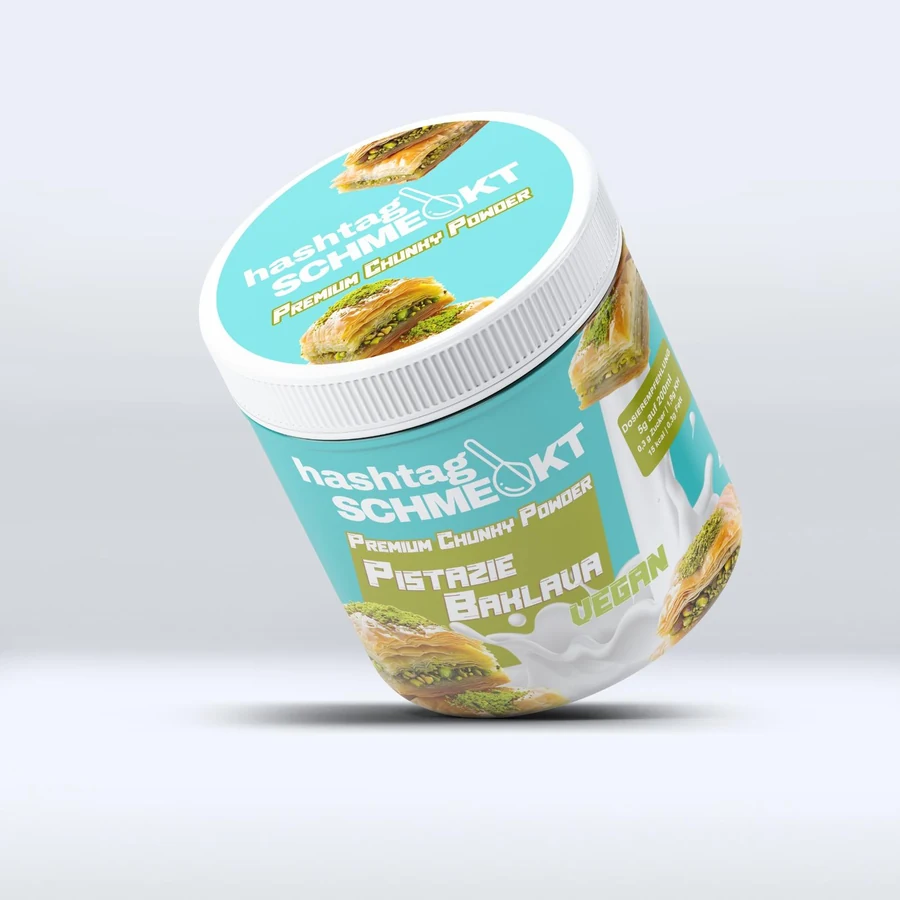
Want to bring the pistachio-baklava trend into your range? The VOVAN own brand #schmeckt offers a vegan chunky powder with pistachio-baklava flavour - perfect for placing the viral taste as a listing. More on the market and listing strategy in our pistachio-baklava-powder trend analysis 2026.
Frequently asked questions about baklava
What is baklava?
Baklava is a Middle Eastern filo pastry made of wafer-thin filo dough (yufka), layered with chopped nuts - usually pistachios or walnuts - and soaked in sugar syrup or honey after baking.
What is baklava made of?
From filo dough (yufka), a nut filling of pistachios or walnuts, butter or ghee between the layers, and a sweet sugar syrup or honey.
Where does baklava come from?
Baklava has its roots in the Middle East and was refined in the Ottoman court kitchen. Today it is widespread above all in Turkey, the Levant, Greece and the Balkans.
Is baklava vegan or vegetarian?
Classic baklava is vegetarian, but usually not vegan, because butter / ghee and partly honey are used. Vegan versions use plant-based margarine and pure sugar syrup.
What does pistachio baklava taste like?
Intensely sweet, buttery and nutty with a crisp texture - the pistachio brings a mild-green, slightly earthy aroma, the sugar syrup the characteristic juiciness.
Why is baklava such a trend in 2026?
Because its core ingredients pistachio and kadayif (angel hair) form the base of the viral Dubai chocolate. As a result, pistachio baklava has become a stand-alone flavour in chocolate, ice cream, powder and snacks.
Discover #schmeckt → Register as a Retailer